30 Day Disney Princess Challenge: Day 2

30 day princess challenge badge

Day 2: Favorite Princess

belle brave

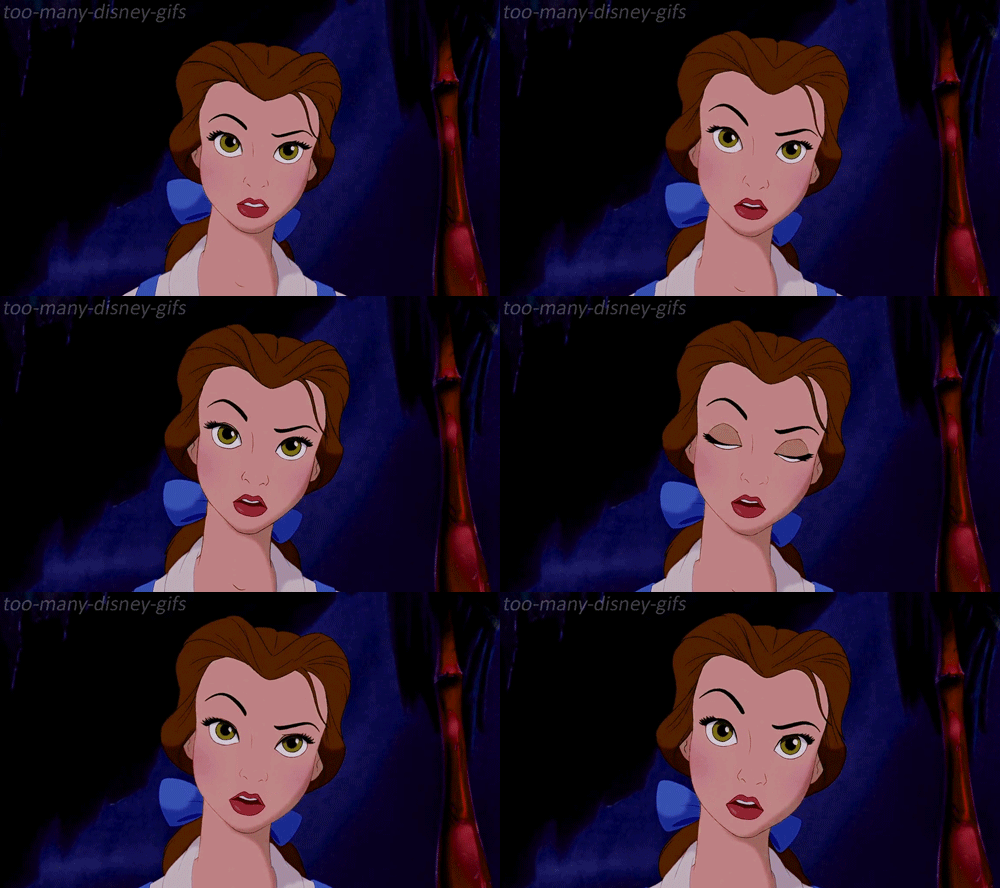
Belle from Beauty and the Beast

Belle is my favourite Disney Princess.

I love that she was different to the classic princesses that had gone before. Showing more similarities to her contemporary, Ariel, she was whip-smart, bookish, with a craving for adventure and didn’t fall for the charms of the local village hero Gaston.

I love how although she thinks she wants a grand adventure, she quickly comes to realise that being held prisoner in a creepy Gothic castle might not be it.

I love how she sacrifices her own happiness to save her father and then returns to the castle once the Beast lets her go. She’s loyal as fuck to those she loves.

I love how she’s sweet and kind and looks past the Beast’s fearsome exterior to fall in love with him. even if she wasn’t ‘rewarded’ with a handsome prince, I think they would have been happy. I love the Gothicness of the story, with an innocent young girl trapped in a Gothic castle with a man intending to be her beloved. There’s something about that trope I really like. I also really like the whole love story, from the antagonistic beginning between the couple, to a growing mutual respect, like, and admiration.

I like that she’s physically different to the other princesses as well. She’s the only brunette (not counting Rapunzel) and she’s the only one with hazel eyes. I think those differences help make her live up to her name.

And despite it all, I like that she wasn’t born royalty but married in to it. That’s not very common with the Disney Princesses.

Contradictory Characters? Characteristics Don’t Have To Match

contradictory characteristics

Recently the Miss USA was crowned, and I was blown away by the woman, District of Columbia entrant Deshauna Barber.


  • She’s not only incredibly beautiful, but she has a master’s degree in management information systems and works as an IT analyst for the United States Department of Commerce.
  • She is a logistics commander for the 988th Quartermaster Detachment Unit of the United States Army. She joined the military when she was 17 and sees it as a family tradition.She wants to use her Miss USA reign to focus on PTSD treatment for soldiers returning from the war.
  • She was a sorority sister in a chapter that focuses on leadership and educating youth.
  • She cried when she won Miss USA.

This woman, this amazing, phenomenal badass, breaks stereotypes just by being herself. She’s ‘a mess of contradictions in a dress’, as Fiona from Shrek the Musical says.

Uncharacteristic

I don’t really like saying that a character’s actions are ‘uncharacteristic.’ Take for example Fluttershy from My Little Pony. She’s shy, she’s a pushover, she’s extremely kind and basically lets that demon bunny Angel get away with anything.

But Fluttershy’s also got this ‘stare’ that she uses on animals when they won’t do as she says. It’s very uncharacteristic  for Fluttershy to be bossy or mean.

fluttershy stare

Or is it?

When called for, Fluttershy can do anything, including joining in on Nightmare Night despite being afraid of everything, and helping Rainbow Dash bring water to Cloudsdale despite being a poor flyer.

Some characteristics can appear to be contradictory but it’s the author’s job to try to make them seem realistic. Unfortunately there’s a lot of readers out there who find contradictory characteristics to be unrealistic, despite it happening in real life.

Take me, for example.

I’m an introvert. I’d even go so far to say that I’m a little shy. People are constantly amazed that someone like me can get up in front of thousands of people and bare my soul by belting out a solo in musical theatre.

Shy people are supposed to get stage fright, right? Shy away from the spotlight. Only extroverts gambol about onstage because they love the attention.

And it’s true, I can’t break the ice with strangers. My voice literally sticks in my throat and I get so nervous I feel like I’m going to throw up.

Except for the time I walked up to and introduced myself to the Prime Minister of Australia.

See?

I’m also a mess of contradictions in a dress.

Realism And Suspension of Disbelief

And when it comes down to it, it’s not just about ‘realism’ or how well the author writes. It’s also up to the reader to suspend their disbelief. If they can’t handle a sweet and sassy ‘traditional’ princess who can also kick butt to defend herself yet never escapes from the dragon keeping her hostage, no matter how well the author writes it, the reader just isn’t going to accept it.

But maybe they should remember that the District of Colombia Miss USA 2016 winner is a badass military leader and a IT expert smashing gender expectations and contradicting her own characteristics everywhere she goes.

30 Day Disney Princess Challenge: Day 1

30 day princess challenge badge

Favorite movie

tangled-movie-title

Why is Tangled my favourite Disney Princess movie?

For a long time it wasn’t. For a long time Beauty and the Beast was my all-time favourite.

Both films contain heroines I can identify with. Belle is bookish and uninterested in succumbing to peer pressure. Rapunzel leads a sheltered life until one day she follows her heart’s desire and leaps into the world to explore.

Both films have pretty big plot holes I’m perfectly happy to overlook. Beauty and the Beast has the painting that is of a 21 year old, not an 11 year old, and if Mother Gothel had changed Rapunzel’s name and birthday she probably wouldn’t have realised she’s the lost princess.

Both films contain ridiculously handsome heroes that don’t get along with the princesses at first. This is actually one of my favourite romance tropes.

I think I’d have to compare Tangled to Beauty and the Beast to figure out why I like it better.

Tangled’s art style tried to visually recreate an oil painting, which I think is gorgeous. But B&TB has the 3-D ballroom scene.

Both films are framed around the story of the male hero, though Tangled is marketed as much more gender-neutral. If you’ll recall, both films open up with the male’s story, in B&TB’s case the stained glass window story and in Tangled’s case opening on Flynn saying ‘This is the story of how I died.’ Both of them are about the redemption of the male hero through their love for the princess.

The soundtrack of both are pretty good. I love Mother Gothel’s songs, but absolutely nothing can beat the classics in B&TB. I love how the actors do their own singing.

Overall I tend to prefer animal sidekicks, and fencing an angry horse using a frying pan has got to be one of the better scenes Disney’s ever done. Pascal’s a unique companion as well. The sidekicks in B&TB are household objects and beg to asked, did Chip just stop ageing?

As for the villains, well, Gaston’s pretty scary when you think that the whole village admires him. His need to destroy the Beast because Belle rejected him is excellent motivation. On the other hand, Mother Gothel is the mistress of manipulation and you have to ask yourself, is she really a villain or simply misguided? Does she really love Rapunzel or just using her for her magic? (I believe that she she has some degree of affection for Rapunzel, but the primary motivation is Rapunzel’s magic. That’s why she ‘s afectionate towards Rapunzel’s hair, not Rapunzel herself, calls her ‘flower’, and tries to pick up the hair when Flynn cuts it off.) On the other hand, when Gaston falls to his death, if you pause it at the right time, you can see skulls in his eyes.

Overall I think Tangled edges out Beauty and the Beast simply because they are from different times. B&TB will always be a favourite classic, and Rapunzel is of the new generation of princesses. Disney learned a lot between the two films, with B&TB being a runaway success and leading the way for films like Tangled.

Should authors produce similar content?

similar content

This was one of my problems when I first published an adult novel and then switched to Young Adult.

Branding

Should authors produce the same kinds of stories? Personally I loved reading Maria V Snyder’s Poison Study series and then the Healer series and finding them both basically the same kind of story, with the same type of heroine, love interest, and even a pair of allies who treated the heroine like a sister.

The same with David Gemmell’s heroic fantasy novels – mostly starring loner former heroes past their prime (Druss, Waylander, Jon Shannow) or young outcasts (Skilgannon, Gaelen) with a token warrior woman who will still need rescuing, often with some kind of man-beast hybrid that would have to be murdered eventually. I could pick up any Gemmell book and know exactly what I would be getting. There is always a quiet swordsman, a brute, and an archer in the team novels.

John Green writes manic pixie dream girls and boys as love interests.

Rick Riordan writes about descendants of mythological gods.

Cassandra Clare writes thinly veiled Harry Potter fanfiction.

Richelle Mead writes YA heroines who are smart and sassy and go-getters.

Stephanie Meyer specialises in weird love triangles.

Is this a good thing or a bad thing?

Personally I like being able to say, “I feel exactly like a David Gemmell novel” and being able to pick up one that hits all the right buttons.

My own writing

Both of my full-length novels are wildly different.

  • Adult vs teen protagonist.
  • POC vs white ‘goth’ girl
  • Sci-fi vs paranormal.
  • Established relationship vs new love interest.
  • Deep space vs suburbia.
  • Limited characters vs larger cast.

But there are certain similarities:

  • Strong/powerful female lead
  • Diverse cast
  • Feminist slant on the storyline
  • Both heroines overcome their own issues and are the agents of their own stories
  • BUT both heroines need the help of their friends/allies to do so
  • Both characters’ actions propel the storyline forward.
  • I like to think of them as both active heroines, not passive.

That is what I’m aiming for in my ‘branding’.

In all of the stories I write, I want those similarities to be there. I want someone to be able to identify a Lissa Bilyk novel and be able to say, “Yes, I recognise those elements from her other novels” even though I’m writing in different genres with different plots and different characters.

I want my books to be different but familiar.

Write What You Know: Knowing More Than You Put On The Page

knowing more

As a writer, I feel the need to really know my characters, their situations, their props and settings.

For The Edge of Darkness, that wasn’t so hard. It was largely a made-up world, set in deep space on a spaceship and the weapons used were also made up.

Internet-Based Research

I did some research on amputees and prosthetics to try to get a feel for what Max might be feeling as a cyborg with a robotic arm. I researched what kind of food could theoretically be grown on a spaceship. I researched some other science-y things. But when I wrote the story, I probably knew a lot more than I was putting in to the book.

With Winter Witch, one of my characters wears a monocle. I had no idea how monocles stayed put, so I did some research to better understand my character. I found out how someone inserts and wears a monocle, and I felt like I had a strong grasp on the eyepiece and I wrote it into the book.

When I mentioned the research to friends, another author piped up that she was interested in how people wore monocles. I was surprised, because I was sure I’d read one of her characters in one of her books I’d read actually did wear a monocle. I was surprised because this author didn’t know how her character wore a monocle and she clearly hadn’t done the research into finding it out. Maybe she didn’t care. Maybe it wasn’t important. The character wore a monocle and that’s all we needed to know.

penguin-33203_640

Write what you know.

“Write what you know” is probably one of the most repeated pieces of writing advice out there. And it’s true, you should write about what you know. But you can always expand upon what you know by research.

As for me? I didn’t feel comfortable writing about a character who wore a monocle until I knew exactly how a monocle worked. I think it’s an issue with my perfectionism that I needed to research something so foreign to me. But I didn’t want to make some basic mistake that a monocle-wearing fan might point out in the book.

My character doesn’t even take his monocle off or put it back on, so I’m not quite sure why it was so important to me to know these things. Maybe for future reference? I’m sure I only mention the monocle in passing.

The research I did certainly wasn’t earth-shattering, but as a writer I felt like I needed to know more than I was putting on the page.

I think that’s why we’re told to write what we know.