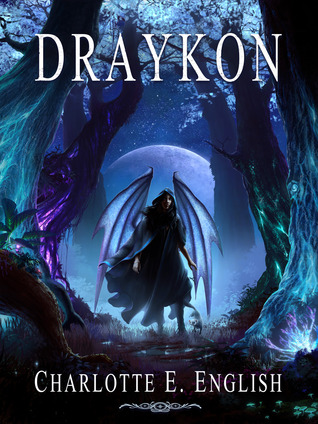
Review: Draykon (Draykon #1) by Charlotte E English

Publisher: Charlotte E English
Genre: Fantasy, Mystery
Pages: 281 pages estimated (ebook)
Release Date: August 31 2011
Source: Purchased.
Rating: 5 out of 5 stars.

Blurb (from Amazon.co.uk)

When shy and retiring Llandry Sanfaer discovers a mesmerising new gemstone, she suddenly becomes the most famous jeweller across the Seven Realms. Demand for the coveted stone escalates fast; when people begin dying for it, Llandry finds that she herself has become a target.
Lady Evastany Glostrum has her life in pristine order. Prestigious, powerful and wealthy, she is on the verge of crowning her successes with the perfect marriage. But when her closest friend is murdered for the jewellery she wears, Eva is drawn into the mystery surrounding the curious “istore” gem.
The emergence of the stone is causing chaos across the Seven. Gates between the worlds are opening at will, pulling hordes of creatures through from the shadowy Lower Realm and the glittering Uppers. As Eva works to discover the culprit behind the spreading disorder, Llandry must learn the truth about her precious istore stone – before she herself becomes a victim.

Review (full review posted on Goodreads.com)

Charlotte has an obvious gift for beautiful prose and many a time I caught myself drooling over her wonderfully constructed sentences. Her word choices are elegant. She doesn’t just choose simple words to get the point across, either, but words that are musical and almost seem to jump off the page. Harmonious, that’s what it is. But I didn’t have to crack open my dictionary to discover the meaning of any of the words. It was just nice clean beautiful prose, and ten times better than a lot of legacy books out there. Both the voice and the style have been developed beautifully and executed better than I expected.

Her characterisations are very fine and three dimensional. Often I could feel Eva’s susceptibility to the cold and Llandry’s social anxiety, which were both large parts of the character identification. They even had different voices, which is rare to find in indie fiction. That’s why this book is a gem, people! I loved the way Eva dealt with people and could feel the pressure on her to succeed and be seen to be successful. And there are much worse things than being in Llandry’s head as she suffers and deals with her social anxiety.

I would have liked to know how Llandry developed from the fearless child into the anxious wreck she is as an adult, but Draykon has a sequel, Lokant, and I hope we’ll find out there.
Sigwide was so adorably cute. Charlotte clearly has a gift for writing non-anthropomorphised fantasy animals. I loved reading about him: his reactions all seemed very real and he was just so cute! Where can I get an orting?

The worldbuilding was rather lovely. I’m not sure I have a firm grasp on everything, because it’s unlike anything I’ve read before. A lot of the clearly non-human sentient people were called humans, even when they had wings, for example, so I’m still trying to come to terms with that. I don’t fully understand why there needed to be the land and Cloak divide between the Daylanders and the Darklanders but I imagine it came about as the people grew more aware that they could manipulate their own environment, much like the benefits of electricity for us real-world humans. After all, if you’re a nocturnal creature, what could be better than night all the time? And if you have sorcerers able to do that sort of thing, why not give yourself a natural advantage?

The only thing I will mention that was not perfect (besides the occasional typo – not more so than any legacy published novel, so it’s not an issue, and the ever so slight ‘who said that?’ moment when it came to dialogue) is the fight scenes. They seemed not as perfect as the rest of the prose. Polished, yes, and lovingly written, that much is obvious. It doesn’t in any way let the novel down, but after growing accustomed to Charlotte’s high standard prose, her descriptions which never became overwhelming and were just enough to build the world in my head, her wonderful characterisations and the very real relationships between the characters, the fight scenes by comparison (and remember, everything else was top-notch) seemed a little weak, a little off in pace. Almost like a tuba solo in the middle of a glorious symphony. Perhaps Charlotte is not comfortable writing violence, or not as practiced as her gorgeous political banter, high societal manners, and worldbuilding that I enjoyed reading about so much.

That being said, I need to reiterate that the fight scenes were still of a higher quality than I’ve read in legacy books. They just don’t seem to match the rest of the novel in its perfection.

As for the plot: well, she wasn’t kidding when she billed it as a fantasy mystery. After the appropriate amount of building questions, the revelations were revealed at just the right time. I thought the plot was going one way and it ended up going another way. I also have a suspicious mind so I kept expecting a certain character who shall not be named to be a betrayer, the sort of ‘Ha ha ha, I’ve been playing with you all along’ type thing, but that didn’t happen. The novel seems quite innocent in that regard. Almost everything was neatly wrapped up at the end, with just enough left unanswered to make a sequel appealing.

It’s not a YA book, but it’s a clean read and because of Llandry’s not-quite-grown-up attitude it could be marketed so. I believe a lot of young people would be able to relate to Llandry’s need for independence and her overbearing and overprotective parents wanting to keep her safe.

I’m really looking forward to Lokant, and the third book, Orlind, which was recently released.

Style: not just something you’re born with

I try not to give much writing advice on this blog because I only have a lifetime of reading, a four year English degree and two moderate bestsellers to my name. However, there are a few things I want to get off my chest that I’ve come across time and time again not only in beta reads and self-published works, but in traditionally published books as well.

Style. It’s not just something you’re born with. It’s something you can learn. Ignoring style makes your writing look tacky and unprofessional. Readers are inundated with a gazillion books at any one time: they are looking for a reason not to read yours. Don’t encourage them by having bad style.

  • There’s a prevalence in YA of what we reviewers call ‘purple prose’. This is overly-wordy sentences and metaphors or descriptions that make no sense, like ‘cat-green eyes’ (which book is that from again? Someone please remind me!). Because really, I’ve never seen a green cat. Don’t try to overdo your writing. Simple and plain prose can be just as effective as poetic prose, and you’re much closer to not crossing the line into purple.


  • Some people don’t know when to start a new paragraph. One paragraph contains one idea and should maintain a logical flow of information. Dialogue almost always starts on a new line, unless it’s the same person talking. If they’re talking about a new subject, that’s a new idea: so start a new paragraph.


  • Learn how to use apostrophes. In the plural form of a shortened word, do not add the apostrophe. “I checked all my PM’s.” = WRONG. “My PMs all say the same thing.” = RIGHT


  • There is a difference between passive sentences and past progressive tense. Learn it. Use it wisely. Do not accuse people of writing in passive voice when they are writing in past progressive tense. Similarly, do not write in passive voice. Active sentences are built as such: person doing the action – the action itself – the object. ‘The waves crashed on the beach’ not ‘the beach had waves crash on it.’

Remember above all to have fun. That’s not stylistic advice, that’s just general advice from me.

Review: Fever (Chemical Gardens #2) by Lauren DeStefano

Publisher: Simon & Schuster Children’s Publishing
Genre: Young Adult, Dystopian
Pages: 341 pages (hardcover)
Release Date: February 21 2012
Source: Purchased.
Rating:4 out of 5 stars.

Blurb (from Amazon.co.uk)

For 17-year-old Rhine Ellery, a daring escape from a suffocating polygamous marriage is only the beginning…

Running away brings Rhine and Gabriel right into a trap, in the form of a twisted carnival whose ringmistress keeps watch over a menagerie of girls. Just as Rhine uncovers what plans await her, her fortune turns again. With Gabriel at her side, Rhine travels through an environment as grim as the one she left a year ago – surroundings that mirror her own feelings of fear and hopelessness.

The two are determined to get to Manhattan, to relative safety with Rhine’s twin brother, Rowan. But the road there is long and perilous – and in a world where young women only live to age twenty and young men die at twenty-five, time is precious. Worse still, they can’t seem to elude Rhine’s father-in-law, Vaughn, who is determined to bring Rhine back to the mansion…by any means necessary.

Review (full review posted on Goodreads.com)

Fever takes up where Wither left off, with the escape of Rhine and Gabriel from the opulent mansion where she was a Gothic-style prisoner and he was a servant.

And it never bloody slows down.

From the new capture of the couple to their daring escape, to their lonely trek to Manhatten and Rhine’s subsequent recapture, the book – despite about half of it being flashback, pondering, and the delirium of the ‘fever’ the book is named after – the story moves at a breakneck speed that left me breathless. After the first book, Wither, took place over nearly ten months, it was a shock to live so briefly in Rhine’s head again.

I’m pleased to announce I had another big emotional response as well. During the part early-ish on when Rhine, Gabriel, Lilac and Maddie are hiding in the long grass from Madame, and Rhine has a flashback to her Gathering, I swear I felt Rhine’s terror. I’ve never been so scared reading a book in all my life, except when I first read Black Beauty and was convinced the titular character was going to die several times. But hey, I was seven. Cut me some slack.

I loved the way this book developed. This is a sequel to rival its first book. Not exactly better – I still had an issue with the plot. This time it was because Rhine was oh-so-special because she ‘happened’ to look like Madame’s dead daughter, so she got preferential treatment and despite living with prostitutes, was not expected to service customers of her own. I mean, yeah sure, I get that Rhine has to have interesting stuff happen to her but I kept thinking, ‘Oh God, I hope the whole book isn’t about living with Madame, otherwise it’ll be just like the first book.’ Rhine’s special, again, because she looks like the deceased loved one of the most powerful person. Luckily, this didn’t last as long as I thought it would.

The only other issue I had is completely out of DeStefano’s hands. I don’t like how damn big my version of the book is. It’s hard to hold in one hand and read. I love the cover – except for those stupid circles again! It’s making the subtleties of the cover way too obvious, and it annoys me. Kudos to whoever read the book and said, ‘We need the following details,’ but really. I can figure out what the points of interest are just by looking and reading the book. Those circles are stupid and pointless if you’ve not read it, and redundant if you have.

I loved the development of Rhine and Gabriel’s relationship. They’re so realistic to me. They have issues and communication problems just like everyone else. They aren’t perfect: they’re simply two people, bound by a love they haven’t even voiced yet. And Rhine’s got goals beyond just being with Gabriel.

The development of the plot outside of Rhine and Gabriel’s journey was handled pretty subtly. Without spoiling, it’s all coming together for a huge climax in Book 3.

What else can I say about this? I love Lauren’s prose so much that I was swept into the narrative. She has a magical way with words. It’s her literary background, I believe. Everything about the technique is perfect.

I for one am terribly anticipating Book 3. Please, please don’t call it ‘Ever’.

Sirengate: My Two Cents

I’ve not wanted to say anything about Sirengate (which, despite happening in January, has only come to light recently) because, although it saddens me, it doesn’t affect me directly. I don’t follow the Story Siren (because I don’t enjoy her reviews) and I’ve kept to a small section of the book blogging world (Goodreads) until recently.

But now I’m breaking my silence, for what it’s worth. Not much, I know, but still.

Not to talk about the Story Siren. Well, not directly. More to talk about her fanbase.

Let me clarify: there are people who have lost respect for the Story Siren and have dropped all ties. There are people who have forgiven her for her transgression and moved on. And there’s a third group, who have taken it upon themselves to attack the original victims of the Siren’s crime. The people who run the blogs she plagiarised. The victims whose words she copied, knowing full well what plagiarism is.

I’m clarifying again, because it took me a few moments to realise myself: the plagiarist’s fans are sending hate mail to the victims of the plagiarism.

I don’t know what the hate mail is saying, but I can guess. It’ll be along the same lines as Cassandra Clare’s fans when they conveniently forget her fanfiction was deleted off Fanfiction.net for plagiarism. Clare never confessed to her plagiarism, spinning a story that it was a game between her friends. The Story Siren has spun another story that takes the blame off her: that she didn’t realise, that it was a mistake or wasn’t deliberate, that she was confused, that she’s sorry and she doesn’t expect anyone to understand.

The similarities between the two events are somewhat similar, but the overwhelming similarity is how the fans who love her have reacted.

I’m not saying the Siren’s a criminal, but it’s similar to the family of a thief going to arms against the police when the thief is arrested. Someone has been wronged, and it’s not the Siren.

I don’t agree with going after the Siren with pitchforks, because everyone screws up every now and then. I don’t want this swept under the rug. But I certainly must condemn the fan reaction and backlash against the innocent bloggers who ‘dared’ to reveal the plagiarism. They didn’t even name her. It was the book bloggers who revealed who the plagiarist was.

It makes me terribly sad, and a little angry.

Since when has popularity been a replacement for integrity?

Review: Wither (Chemical Gardens #1) by Lauren DeStefano

Publisher: Simon & Schuster Books For Young Readers
Genre: Young Adult, Dystopian
Pages: 358 pages (hardcover)
Release Date: March 22nd 2011
Source: Via the author in exchange for an honest review.
Rating: 4.5 out of 5 stars.

Blurb (from Amazon.co.uk)

What if you knew exactly when you would die?

Thanks to modern science, every human being has become a ticking genetic time bomb – males only live to age twenty-five and females only live to age twenty. In this bleak landscape, young girls are kidnapped and forced into polygamous marriages to keep the population from dying out.

When sixteen-year-old Rhine Ellery is taken by the Gatherers to become a bride, she enters a world of wealth and privilege. Despite her husband Linden’s genuine love for her, and a tenuous trust among her sister wives, Rhine has one purpose: to escape – to find her twin brother and go home.

But Rhine has more to contend with than losing her freedom. Linden’s eccentric father is bent on finding an antidote to the genetic virus that is getting closer to taking his son, even if it means collecting corpses in order to test his experiments. With the help of Gabriel, a servant she trusts, Rhine attempts to break free, in the limited time she has left.

Review (full review posted on Goodreads.com)

Contrary to just about everyone else, I don’t like this cover.

I like the model and her hair and makeup and dress, and I like the set decoration. What I don’t like is those stupid big circles around Rhine’s ring and the bird in the cage. DeStefano started out as a literary writer, and the stupid circles linking Rhine’s marriage to the caged bird is way too obvious for the subtleties of literary novels. I hate those circles. They ruin a gorgeous cover.

Wither is a very atmospheric book, a stifling Gothic tale of a young beauty trapped in a big house with an older gentleman. What makes this different to other Gothic novels is that Rhine is in a polygamous marriage that is linked to slight dodgy worldbuilding in that all women die at age 20 and all men at age 25. So young girls are stolen off the streets and forced into marriages, prostitution, or shot. That part makes no sense to me and is why the book loses half a star. I don’t know DeStefano’s logic in this but surely girls would be a valuable commodity in this weird future, so why on earth would anyone shoot them for not being pretty enough? A breeder is a breeder, a womb is a womb. I can understand the girls being reduced to baby factories but I can’t quite wrap my head around them being disposable. After all, that’s the point of the polygamous marriage. Stick five women and one man together and tell them to breed and in a year you’ll end up with five babies. Stick one women and five men together and in one year you’ll only have one baby. So with the culture revolving around polygamous marriage – namely unwilling polygamous marriage – I just can’t quite understand why rejected girls would be shot.

Some people complain that having the United States as the only country left in the world and the polar ice caps melted as not working either, but I’m of the opinion that Rhine is an unreliable narrator. We as the audience can only know what Rhine knows, and if she’s been taught something – say, that the United States is the only country left in the world as the others have been destroyed by wars – then that’s what she’s going to tell us. Doesn’t mean it’s necessarily true. So I’m of the belief that Rhine’s wrong.

Apart from the weird worldbuilding, the actual story itself is breathtaking. Like I said, it’s an atmospheric Gothic polygamous marriage tale, and it’s very powerful. It actually caught me by surprise, especially something that happened to one of Rhine’s sister wives. I won’t spoil it, because I found it so emotional that even though I was annoyed that I had to go do normal stuff like eat and sleep and work which interrupted my precious reading time, I willingly put the book down and dissolved into noisy sobs in my partner’s arms. I just… I can’t even. I didn’t even like the character and here I found a huge emotional response.

That’s how I judge books. I judge them on how they make me feel. I feel that Wither was amazing, but the worldbuilding needs half a star knocked off. It made me cry. It make me laugh. I loved the pace and the plot and Rhine’s character. She has a very minor flaw that makes her speshul, but apart from that she’s a caring, manipulative, awesome heroine. She never gives up on what she wants, she never loses sight of it and she goes through a lot to reach her goal. She doesn’t need saving, she has goals that extend beyond becoming someone’s girlfriend. She’s realistic and probably one of my favourite heroines. I loved living in Rhine’s head while all those new relationships developed.

I was very pleased when I read the end and I’m very much looking forward to reading the sequel, Fever.