30 Day Book Challenge: Day Nineteen

Day Nineteen: A book that changed your mind about a particular subject (non-fiction).

The Complete Idiot’s Guide to Philosophy.

I took a Philosophies of Modernity class in my final year of University. It was a poor decision: I didn’t enjoy any of it. I took it because I really enjoyed modernity from a sociological perspective, and this was the only course left that fit my timetable. I also thought, that because I really kind of hated philosophy so much, that this course might help me change my mind.
I bought the book to help give myself an overview of philosophy and perhaps make the course easier. It didn’t. But at least now I understand philosophy. I still think it’s a load of bollocks: there is nothing I hate more than people standing around musing to each other about how mysterious the universe is. I hate that they’re always asking questions and never bothering to find answers. The answers are out there: maybe not today, maybe not tomorrow, but they are out there.

However, instead of hating philosophy so much that I simply shut down at the mere mention of the word, I now can listen to and understand people when they start farting on about it. I still don’t enjoy it and I certainly don’t understand it, but at least now I won’t stay utterly silent and let people who think they’re smarter than me get away with random and vague assertions trying to show how deep and knowledgeable they are when they’re really just as confused as I am.

30 Day Book Challenge: Day Eighteen

Day Eighteen: A book you can’t find on shelves anymore that you love.

Hunter’s Moon by Garry Kilworth.

A book about foxes? Yes, please. As I mentioned in my Day Nine review, “I grew up in the only place in the world, bar Antarctica, where foxes do not live.” I love these animals so much, and I’ve never seen one in real life, not even in a zoo. They are the most interesting, wonderful, beautiful creatures I have ever read about. I love them.

I’ve read one other Kilworth book (I don’t remember the name, but it wasn’t an animal one), read reviews of others, and I’m strongly of the opinion that this is his best book. It not only tells the life story of an English vixen, O-ha, and what happens as her native wood is redeveloped into a town, but it also gives an account of the mythology of the foxes and explains why dogs and wolves and foxes, although cousins, are also enemies. It tells the story of foxes through fox eyes and pulls you so far into the story that you can really imagine what it must be like living through uncertain times at the mercy of humans ruining your home.

O-ha’s story is a sad one. He loses her first mate, A-ho in a fox hunt, and her first litter to human cruelty. Then she meets Camio, and American red fox who escaped from London Zoo. Their romance isn’t easy, because O-ha is still grieving for A-ho and her lost litter, but the story also follows her and Camio’s litter and their stories as well.

The characters are so well written, and they develop beautifully, even the cubs. O-ha’s a traditional fox, and Camio’s more progressive. Their arguments on raising their cubs are priceless. O-ha insists on teaching them all the traditions that have kept the foxes alive, even though they no longer apply. Camio’s such a great daddy that he goes along with her for the sake of the cubs.

This book isn’t suitable for children, though I would happily give it to a teenager. Only because there is a lot of death, blood, violence, a smattering of animal sex, and heavy themes that are hard for young minds to grasp. I read it when I was about thirteen or fourteen, borrowed from my school library, and hunted for my own copy for years after. I found a copy in a second hand bookstore when I was in my early twenties. I told the bookseller she’d made my week. I was so excited to have my own copy.

It was first published in hardcover in 1989.

30 Day Book Challenge: Day Seventeen

Day Seventeen: A book turned movie and completely desecrated.

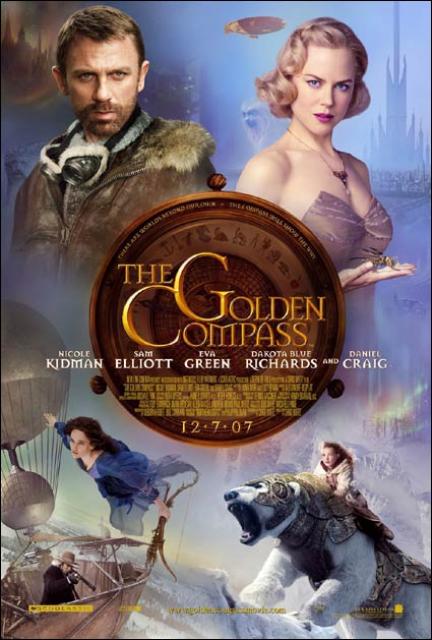
The Golden Compass by Phillip Pullman.
Note – also called ‘Northern Lights’ outside of the US.

There are so many books out there that when turned into a movie are considerably crap. In fact, the only films I have ever seen that I liked better than the books are Lord of the Rings, The Silence of the Lambs and Sex & The City.

Now, I absolutely loved The Golden Compass in novel form. I first read it when I was sixteen, and every time I re-read it, I still find little gems and deeper meanings to so much.

I also loved the film. It wasn’t successful because of the religious movement sticking on the fact that God dies in the second book (they were saying the two protagonists murder him but they don’t) and the fact that the book questions religion in a parallel world. I also had some pretty big issues with casting – I wanted Jason Isaacs SO BADLY to be cast as Lord Asriel (and so, apparently, did Pullman), but they cast Daniel Craig (who was good, just not who I wanted) and Nicole Kidman’s Mrs Coulter didn’t have black hair.

I have this full-sized poster framed, given to me on my 21st by my best friend.

I really loved the film. I was very excited to see it and was only a little bit disappointed, and I was only disappointed because the film had to stuff so much into one feature length and it missed so much of the other stuff in the book. They really boiled it down to an adventure story where Lyra goes off to rescue her friend. Yes, that’s what the book’s about, too, but it’s also about SO MUCH MORE.

I can’t bring myself to say this was ‘desecrated’ because unlike most people, I actually approach a film adaptation as a film in its own right and try NOT to compare it to the book. As a film in its own right, it was totally freaking awesome. Compared to the book, it is practically NOTHING – the book is just THAT amazing.

But I do recognise that this book is only one of many that when turned into a film loses part of the magic.

30 Day Book Challenge: Day Sixteen

Day Sixteen: Your favourite book turned movie.

Lord of the Rings by JRR Tolkien.

I can easily say this is my favourite book turned movie, because while I wish I had never wasted my time reading this boring testosterone-overloaded epic, I really really loved the films.

I agree with every single change Peter Jackson and his writing team made to the adaptation to make it into a better movie. Every single thing: all the timeline changes (Boromir dying at the end of the first film, Shelob appearing in the final film etc); making Frodo younger; eliminating Tom Bombadill; making Arwen more important and having a bigger presence; making Sam and Frodo’s relationship more interesting with more drama; and many, many others details I can’t be bothered writing here. There are a lot.

Even though I am a fantasy reader and a fantasy writer, I found the book boring and uninspiring. The films, on the other hand, were excellent, the best non-faithful film adaptations ever made. I own the Extended Editions, as I find them even better than the theatrical releases. I don’t see how another film adaptation could ever be made, and be made better than these.
And finally, I need to express the fact that yes, Tolkien is a genius and yes, he is the father of modern fantasy, and yes, I do understand that he invented orcs and was the first person to make elves tall and willowy (as opposed to Santa’s elves) and yes, the story is amazing and the characters are awesome. The films couldn’t have been so wonderful if it weren’t for this source material. However I, personally, did not enjoy reading the books. It’s just not my cup of tea. It was very dry and methodical – I get that from my academic readings, not my fiction. So don’t get all up on your high horse and tell me I don’t ‘understand’ fantasy or that I’m not a fan. The films were simply better.

Why I Decided to Ignore Legacy Houses & Self-Publish

I always had a secret desire to be an author, but was taught from a young age that it was unfeasible. Growing up in the 90s, only people like Roald Dahl and Jodi Picoult and Stephen King got published. I was taught to focus on obtaining a ‘real’ job and only do my writing in my spare time. And I was always good at it: consistently high grades for creativity and so forth at school.

By the time I hit University, I was working towards a basic Arts degree because it was essential to get into the director’s course at NIDA. (Yeah, I honestly thought I had more of a chance at being a film/TV director than being a published author.) While I was doing my degree, the rules changed: you had to go through the acting course to get into the director’s course. I didn’t want to be an actor, I wanted to be a director. I had already invested time into this degree and didn’t want to waste it, so I re-thought my options.

In my third year, I chose to do a writing course. I already knew how to write creatively – a half-written epic fantasy and dozens of other short or unfinished stories. As part of the course we had to critique others. It was then that I fell in love with editing and helping a manuscript become great. So I decided, as being a published author was still too hard to break into, that I would rather work in a publishing house as an editor.

Right? I know. Cue laughter. Traditional publishing – especially the Big Six houses – is one of the hardest industries to break into. I even decided to do an extra year of Uni to get an Honours degree in something respectable – Shakespeare – to help me when I moved to England.

When I did move to England, the crickets chirped and all was quiet on the job front. I started a blog to ensure I was writing at least every two days, tried to find a job, wrote more stories and yearned to finish my fantasy novel, topping out now at 120K words.

No one cared about my degree. It only really helped me write my fiction better. After I competed in NaNoWriMo in 2010 and actually finished my very first full-length novel (The Edge of Darkness), I looked into self-publishing.

I always thought that maybe my fantasy series (which at that point was still only one book, Dadewalker) would get rejected from traditional publishing because it contains underage sex and pregnancy, gory violence, and strong horror themes while still being an epic fantasy without dragons, elves, or wise old wizards in pointy hats. It’s also written in 1st person from two points of view (my heroine and her shapeshifting sidekick), and my heroine is not like any of those paranormal heroines who remain passive and are victims of circumstance: my heroine actively shapes the plot of the entire series. One of her best friends is gay, and this isn’t a big deal. The love interest is not even introduced until the second book. All of these things, in my opinion, make the novel traditionally unpublishable.

But I believed there was a market for the type of books I was writing. Turns out I was writing books aimed specifically at women like me. Of course, I was writing what I wanted to read: strong women who ignore traditional gender roles and don’t need to be rescued by a big strong man. Buffy the Vampire Slayer in the 17th and 25th century. A Xena without all the Warrior Princess stuff. A Mulan of her time: not without fear, but feisty, brave, and capable.

I believe there is a market for my books. I hope I’m right. I’d hate to think that this journey, my ‘calling’ if you will, the thing I have wanted since I was a little girl – my dream rolled up and stuffed into a bottle, and almost delivered to the Archive of Lost Dreams – isn’t my path in life.