30 Day Book Challenge: Day Eight

Day Eight: An unpopular book you believe should be a best-seller

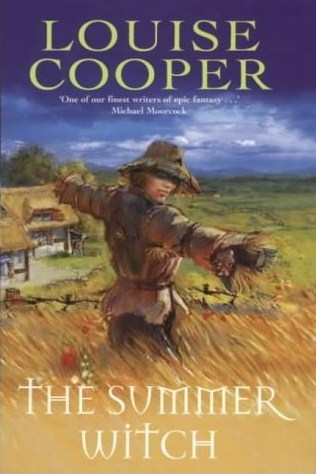
The Summer Witch by Louise Cooper

Louise Cooper had this uncanny ability to really delve into what it must be like to be insane. It’s like a study of Medieval madness. It leaves me spellbound.

No other author I’ve read can make the most boring or innocuous of scenes (like a stuffy Council meeting) seem riveting and interesting.

The Summer Witch is a beautiful piece of work because everything starts off harmlessly enough, and then Carys (the protagonist) gets in over her head and everything falls completely apart.

But it’s like a frog in hot water – he’ll jump right out if it’s boiling, but slowly heat it and you can easily cook him. That’s what the story is like. Things happen almost innocently, and harmlessly, but they all build up into a dramatic crescendo of madness and magic.

Carys’ greedy father sells her to an old widower, and although she’s a virgin she doesn’t want to stay that way. While her new husband never makes a move on her, she develops a game of make-believe with a scarecrow in a field. She is then granted magical help by mysterious gypsy-folk, and her imaginary lover becomes real. She also gains some magic power of her own, as her new love Robin teaches her the ways of the wild and magic.

Eventually, Carys gets too far over her head, and she’s unable to cope with everything. And also, Robin is awesome. I can’t say more or I might spoil it.

I first read The Summer Witch when I was a teenager, and I’ve been looking for my own version for years. I finally got my hands on one in 2010, but unfortunately, Louise Cooper died of a brain aneurysm in 2009.

Her death is a great loss, because she is my absolute favourite author in the whole world, and she’s not really very well known. She weaves a story perfectly, and The Summer Witch is my favourite of her stand-alone novels.

30 Day Book Challenge: Day Seven

Day Seven: A book that’s hard to read.

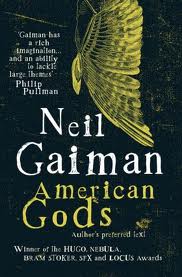
American Gods by Neil Gaiman (author’s preferred text).

It’s taken me two months to finally give up on this book.
This book is in fact so hard to read, for me, that I’ve shelved it 385 pages into 640.

I’ve decided to shelve it and maybe wait a few years to see if I actually do care enough to find out what happens next (like China Melveille’s Perdido Street Station, which I shelved a mere 20 pages or so from the ending).

Gaiman surely is a talented writer. I’m not criticising him. I admire and respect his imagination and his brain, and his writing is easy to read.

What I don’t like about American Gods is the emotional detachment of the main characters, and that no matter how hard I try, I simply can’t care about any of the characters, or their mission, or the ‘impending storm’ we’re occasionally reminded about.

I also find an alarming lack of detail in some scenes (so many that I can’t even pull and example – it’s completely scattered), and some overwhelmingly detailed descriptions of things I really don’t care about (such as Shadow’s coin tricks – a coin trick is a visual medium, and having to read about them I more often than not skipped over them completely. I haven’t yet found a reason for them being part of the plot).

It’s an interesting premise, but I simply can’t connect to a character that I only figured out wasn’t white 200 pages in. There is a lot of text (600+ pages) but not enough description to make me care. Shadow doesn’t ask questions, and sure I can figure out what’s going on, but I’ve still got a whole bunch of questions such as WHY is this mission so damned important, anyway? And Shadow’s not an inspiring character: he drifts around and does exactly as he’s told, developing an unnaturally strong loyal attachment to a man that doesn’t seem to care about him.

However, I did enjoy all the little short stories between the actual chapters of the book. Gaiman clearly loves this book and did a lot of research for it, which I appreciate. But I haven’t done the same research, and it’s too mysterious exactly who the characters are all the time. I’m reading to be entertained and educated, and I don’t want to go off and educate myself on the minor and uninteresting characters we come across.
BTW I read Stardust, and absolutely loved it. So I’m not Gaiman-bashing: I adore the man. I don’t like this one book.

30 Day Book Challenge: Day Six

Day Six: A book that makes you cry

The MasterHarper of Pern by Anne McCaffrey.

There are a lot of books that make me cry. I could have filled this particular day with a few more. Particularly Harry Potter and the Order of the Phoenix, but I figure Harry Potter is already so well-known that I’d choose one less well known but still powerful.

The MasterHarper of Pern follows the life of Robinton, Pern’s most well-loved citizen, from his childhood as a musical prodigy with a jealous father, to his marriage to a beautiful woman who dies on their honeymoon, to the revolution that destroys Lord Fax’s stranglehold on the holds, and then discovering AIVAS.

Robinton is not only the greatest Harper (kind of like a musician and a teacher) in the world, but he can also talk to dragons and they will respond to him. They do this from a very young age. That’s a queen dragon on the cover, notoriously uptight and dangerous – but child-Robinton is fearless and speaks to her anyway. Dragons only normally speak to their riders. Rob was special from the beginning.

I’m so glad Robinton got his own book, because all through the Pern series I wanted to know more about him. He’s gentle, caring, and tough. He’s like everyone’s favourite uncle. And when he dies (peacefully) I cried like a baby. Like a hungry, angry baby.

30 Day Book Challenge: Day Five

Day Five: A non-fiction book that you actually enjoyed
The Science of Harry Potter: How Magic Really Works by Roger Highfield.

First of all, I have to get up on my high horse about how this question insinuates that non-fiction books are not enjoyable. I’ve read heaps. I went to University. I’m so used to reading non-fiction and I find it fascinating. I can easily get addicted to reading science articles. Anyway, let me continue.

This book was so interesting and so informative, I think I read it three times within the space of a month. It delves into all the magic of the Harry Potter world and explains how, using science, it might be possible, either currently or in the future. It sure was interesting reading about the broomsticks and the invisibility cloak, and how Quidditch could be played.

I also read that it was Neanderthals that were red-haired, and when they were bred out of existence, their descendants inherited the ginger gene. Not really sure how true it is (in fact, I think it has been disproved), but it sure was interesting while I was reading it.

30 Day Book Challenge: Day Four

Day Four: A book that reminds you of home.

The Silver Brumby by Elyne Mitchell

What can I say about this magnificent talking horse book? I suppose it’s not exactly a children’s book, although it’s certainly rated G… or maybe PG because of the violence of the fighting stallions. It’s a very realistic portrayal of the Australian bush animals that just happen to be able to communicate in a way readers can understand (hence the speech). But it’s also a magnificent look at the older days of the white settlers, before modern conveniences, and how they treat the native and feral animals. It’s also a big study into jealousy and bullying for our noble silver-coated hero.

The Silver Brumby is in fact a creamy-coloured little colt, named Thowra (which means ‘wind’), born of the same creamy-coloured mare Bel Bel. Thowra is Bel Bel’s first foal of the same colour, and they’ll never forget each other. I think it’s technically some kind of pale palomino, but given that Mitchell makes it very clear Thowra’s winter coat looks silver rather than cream, it could even be some kind of colour I don’t have a name for. My personal version had a dark palamino horse on the cover, and I don’t see how that could ever be ‘creamy’ or ‘silver’.

Thowra is brought up to be very bush-wise, even more so than his contemporaries (except his best friend and brother, Storm, a gorgeous bay stallion). Thowra will be hunted his entire life because of his unusual and rare colour, and the other stallions will be jealous of him. So he needs to be able to run very fast, to avoid his pursuers. He’s brave, resourceful, and cares deeply for his herd. He’s also proud, cheeky, and a lot of fun. As he grows up from foal to stallion, we see him grow into his strength and leadership, and see him even gather an enormous sense of responsibility, like any good leader. His strength and speed grow, and his ability to lose his pursuers gains him a legend-like status, so much so that he’s often referred to as the ‘ghost horse’. He’s also incredibly smart, and knows how to rile up his pursuers, whether they be other stallions or humans on horseback, often goading them into a rage that allows him to escape.

There are so many great scenes in this book it’s hard to pick just one. There are several running scenes where you really feel like you’re seeing the world through a horses’ eyes. There’s magnificent fight scenes between rival stallions (and I cry when Thowra’s father, the magnificent chestnut Yarraman, is beaten to death by his biggest rival, The Brolga, to take over the Cascade herd). There are brumby hunts where you feel the terror of the horses. In winter, when the horses are starving and looking for anything to eat, you feel the desperation in their foraging.

This book reminds me of home because of the most wonderful imagery and descriptions of the Australian bush. Well yes, I did grow up in an entirely different area, and I’m pretty sure the story is actually based in the Snowy Mountains region in southern NSW, but it’s so easy for me to see the bush this way. It reminds me of an Australian Christmas, a gorgeous summer, and I used to read it at least once a year (my version is seriously falling apart). Now I read it whenever I get a little homesick.